आराम से पढ़ें
Neptune: Insights into the Distant Wind and Ice Giant
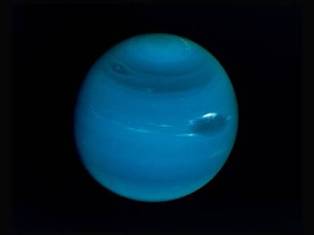
Neptune serves as the final frontier of our solar system, a world defined by extreme weather and icy composition. Despite its distance, it is a critical subject for astronomical research because the majority of exoplanets discovered around other stars share its dimensions. By examining Neptune, scientists gain essential context for understanding other planetary systems and determining the rarity of our own. Currently, our direct knowledge of this blue world stems from a single historical encounter: the 1989 flyby of the Voyager 2 spacecraft.
Isaac Benjamin Harrington
रचनाकार
ओवन नोट
नीचे पूरी रचना पढ़ें।
संग्रह
बेकिंग पत्रिका
The Significance of Studying Our Outermost Planet
Neptune serves as the final frontier of our solar system, a world defined by extreme weather and icy composition. Despite its distance, it is a critical subject for astronomical research because the majority of exoplanets discovered around other stars share its dimensions. By examining Neptune, scientists gain essential context for understanding other planetary systems and determining the rarity of our own. Currently, our direct knowledge of this blue world stems from a single historical encounter: the 1989 flyby of the Voyager 2 spacecraft.
Atmospheric Dynamics and Internal Structure
While Neptune shares a hydrogen and helium atmosphere with Jupiter and Saturn, the presence of methane creates its signature deep blue appearance by absorbing red light. Beneath these clouds lies a massive, high-pressure ocean composed of water, methane, and ammonia. Although classified as an "ice giant," this internal layer is a semi-solid fluid that reaches temperatures of several thousand degrees. The movement of electrical currents within this hot, compressed sea is likely what generates Neptune's uniquely lopsided and intricate magnetic field.
Origin and Orbital Evolution
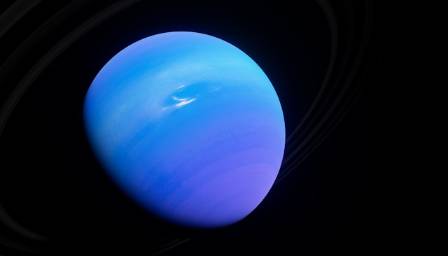
The history of Neptune’s formation remains a subject of intense study. It is unlikely that the original disk of dust and gas surrounding the young Sun had enough density to form a planet of this size at its current distance—30 times farther from the Sun than Earth. Evidence suggests that Neptune, along with the other outer giants, likely originated closer to the center of the solar system before migrating outward. Tracing this journey helps researchers reconstruct the environment of the early solar system during the period when life began to take hold on Earth.
A System of Rings and Moons
Neptune is accompanied by 14 identified moons, many of which appear to be celestial bodies captured by the planet's gravity. The most notable is Triton, a large, spherical moon that bears a striking resemblance to Pluto. Triton features a thin nitrogen atmosphere and active geysers that hint at a potential liquid water ocean beneath its frozen crust. Beyond its moons, Neptune possesses a ring system primarily made of icy debris. Interestingly, the outermost ring is fragmented into five distinct arcs rather than forming a continuous circle, a phenomenon potentially caused by the gravitational influence of the moon Galatea.
Legacy of Exploration and Future Prospects
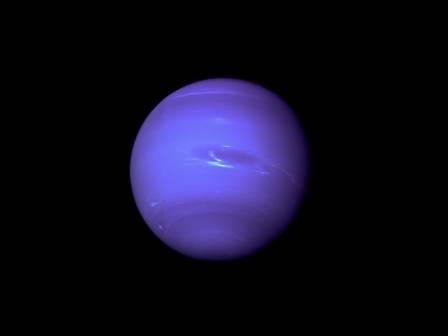
Reaching Neptune is a monumental challenge due to the vast distances involved. Voyager 2 remains the only mission to have visited the planet, recording temperatures as low as -220°C and winds reaching 2,100 kilometers per hour. These winds are thought to be fueled by internal heat leaking from the planet's core. In the decades since that mission, astronomers have utilized the Hubble Space Telescope and advanced Earth-based observatories to track seasonal storms and identify new satellites.
The scientific community continues to advocate for a dedicated orbiter or atmospheric probe to provide a more detailed map of Neptune's gravity and chemical makeup. While some proposed missions have been deferred, upcoming explorations of Uranus in the 2030s are expected to provide "proxy" data that will shed light on Neptune’s own evolution. Understanding these ice giants is the missing piece in our effort to grasp how planets migrate and how our solar system reached its current state.
इसके बाद यह पढ़ें

पेडल कयाकिंग के लाभों की खोज
आदित्य

सिल्क रोड के किनारे सबसे खूबसूरत झीलें और घास के मैदान
तनिष्क

टॉप रग्बी टिप्स: मैदान पर अपने कौशल को बढ़ाना
फिन थॉन्सन

The Rich History Of American Coffee
Cassian Black

10 Iconic Floral Still Lifes You Ought to Know
Cindy

Understanding a Dog's Slumber: How Much Sleep Do They Need?
Emery Jade