आराम से पढ़ें
Beyond Divination: Four Spiritual Uses for the Tarot
When most people encounter Tarot cards, they tend to think of them primarily as a tool for fortune-telling. In reality, Tarot is far more flexible than that. Today, there are countless themed decks available, along with books, guides, and online materials that make learning easier than ever. While the basics—drawing cards and interpreting their meanings—can be picked up quickly, truly mastering Tarot can take years of practice and exploration.
Mason Reed
रचनाकार
ओवन नोट
नीचे पूरी रचना पढ़ें।
संग्रह
बेकिंग पत्रिका
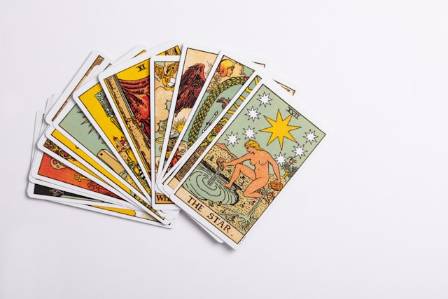
When most people encounter Tarot cards, they tend to think of them primarily as a tool for fortune-telling. In reality, Tarot is far more flexible than that. Today, there are countless themed decks available, along with books, guides, and online materials that make learning easier than ever. While the basics—drawing cards and interpreting their meanings—can be picked up quickly, truly mastering Tarot can take years of practice and exploration.
Over time, I’ve found many alternative ways to work with Tarot that go beyond prediction. These approaches can enrich spiritual practice, deepen understanding of the cards, and even stand on their own as creative or meditative techniques.
Below are several methods I’ve personally used and found meaningful.
Using Tarot for Inner Journey Work
One of the most powerful non-divinatory uses of Tarot is as a tool for inner journeying or guided visualization. A card like The Fool, for example, can act as a doorway into an imagined landscape. When you study the imagery, it can feel like you are stepping into a path or world suggested by the card itself.
From there, you can mentally continue that journey—walking into the scenery, exploring symbolic landscapes, and encountering figures or guides that arise in the experience. Some people interpret this as subconscious exploration, while others view it as spiritual interaction. Either way, the process can offer meaningful personal insight.
To practice this, you might begin by creating a calm, focused environment. Slow breathing helps settle the mind. Place a chosen card in front of you and observe its details carefully. After a few moments, close your eyes and reconstruct the image mentally. Once it feels stable in your imagination, you can “enter” the scene and observe what unfolds. Many practitioners report insights, emotional clarity, or symbolic messages emerging from this process.
Not every Tarot deck works equally well for this purpose. Some decks naturally invite deeper visual immersion, while others feel flatter or more abstract. Still, most can be used with practice.
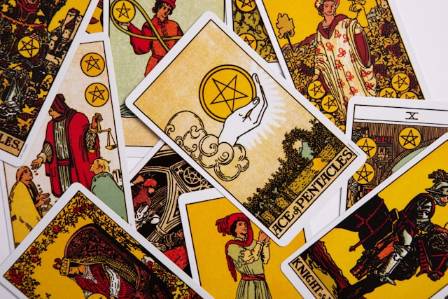
Tarot as a Tool for Sacred Space Creation
Another approach is using Tarot cards as part of ritual space setting. In many spiritual traditions, practitioners call on symbolic directions or elemental forces to establish a sacred environment. Tarot can be incorporated into this structure in a more dynamic way.
Instead of assigning fixed elements to each direction, you can draw cards to represent each quarter of your ritual space. Each card then defines the energy or tone of that direction. This can be done using the Major Arcana alone or the full deck.
By assigning cards to the symbolic directions, the space becomes shaped by living archetypes rather than fixed categories. This method allows for a more fluid and responsive ritual structure, where each reading changes the energetic “map” of the space.
Tarot for Archetypal Study and Self-Reflection
The Major Arcana can also be viewed as a sequence of archetypal experiences often described as the “Fool’s Journey.” This progression reflects stages of growth, challenge, and transformation that can be compared to psychological or mythological models such as those discussed by Carl Jung or Joseph Campbell.
Working with this idea, you can draw a single card and use it as a focus for reflection or meditation. For example, if you draw The Hermit, you might explore questions such as what solitude means in your life, when you seek isolation for clarity, or how introspection has shaped your decisions.
Writing, journaling, or quiet contemplation can deepen this process. Instead of treating the card as a prediction, it becomes a symbolic mirror that reflects internal patterns and personal development.
This method can be especially powerful for understanding recurring emotional themes or life transitions.
Tarot as Creative Inspiration
Tarot can also serve as a source of artistic and creative inspiration. Writers, musicians, dancers, and visual artists often use cards as prompts for creative expression.
A single card might inspire a poem, a painting, a choreography, or even a story. For instance, interpreting the energy of the Queen of Cups through movement or expressing the Three of Wands in visual art can lead to unexpected creative directions.
Many artists have even gone further, designing entire Tarot decks inspired by their own interpretations. Working with Tarot in this way transforms it into a creative framework rather than just a symbolic system.
Final Thoughts
Tarot is often introduced as a divination system, but its potential reaches much further. It can function as a tool for meditation, creative exploration, symbolic study, and ritual practice.
Exploring these different uses can deepen your relationship with the cards and open up new ways of understanding both the Tarot and yourself.
इसके बाद यह पढ़ें
Incredible Building and Architecture LEGO Sets Every Fan Should Know
Steven Lewis

10 असाधारण जेलीफ़िश प्रजातियाँ
माया
Must-See Vintage Sports Cars
Samuel Turner
अपने यूरोपीय दौरे पर देखने के लिए 8 यूरोपीय वास्तुकला शैलियाँ
उर्वशी

दुनिया में सबसे बड़े ईगल्स में से 5
यारा सिमोन
Neptune: Insights into the Distant Wind and Ice Giant
Isaac Benjamin Harrington